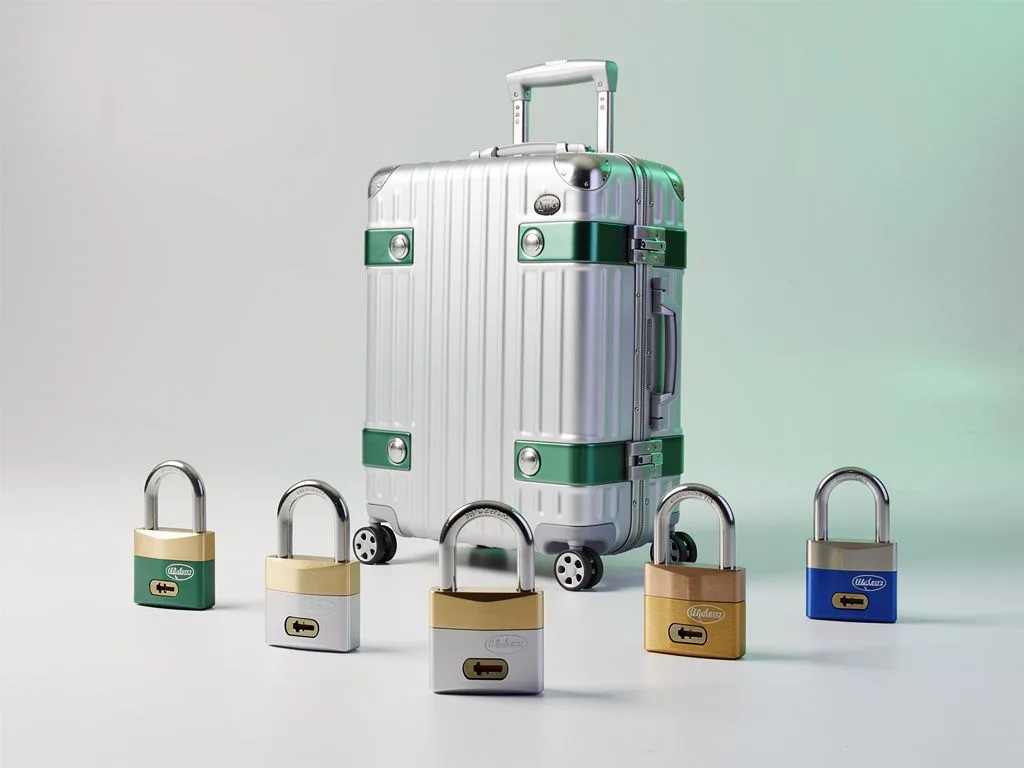
What appearance and branding elements can be customized for TSA travel locks?
Brand collaboration and appearance customization for TSA travel locks mainly focus on the "appearance layer" rather than the "mechanism layer": buyers can specify the lock body color, panel printing, hang tag and outer packaging logos, as well as brand markings on the keys or dials. However, the TSA-mandated cylinder mechanism, certification mark placement, and security key cuts cannot be altered. In the OEM process, Kingtech Industrial first uses DFM to assess which appearance modifications may affect the TSA certification boundary before proceeding to tooling and sampling. Buyers interested in brand co-branding or private-label retail should provide logo files, color codes (Pantone or CMYK), and packaging specifications at the inquiry stage so the factory can determine the feasible scope.
Key Takeaways
Customization is primarily surface-level
TSA travel lock brand collaboration and appearance customization mainly involve the exterior layer, allowing specification of lock body color, panel printing, hang tag and packaging logos, but the lock cylinder mechanism, certification mark position, and security key cuts cannot be changed.
Certification boundaries are non-modifiable
The key cuts of the lock cylinder, internal gear sets of the combination mechanism, the corresponding holes for the TSA master key, and the position and dimensions of the red diamond certification mark are all non-modifiable; altering them will cause the product to lose its TSA certification.
Appearance modifications are concentrated in the early and middle stages
Custom appearance changes mainly occur during the DFM design review, mold development, and prototyping verification stages of the OEM process. Modification costs are highest during mass production, so buyers should finalize all appearance details during the prototyping stage.
MOQ varies by customization item
Simple color changes have a lower MOQ, panel printing or silk screening has a medium MOQ, and custom packaging and hang tags have a higher MOQ. Specific numbers depend on actual specifications; buyers should proactively state their estimated annual order volume and shipping method.
Which appearance customization items can buyers specify?
Common appearance customization items include the injection-molded color of the lock body, pad printing or screen printing on the panel, hang tag and outer box printing, logos on included keychains or straps, and the font and arrangement of numbers on the dial. These items are "surface-level" modifications that do not affect the TSA-certified mechanism, so OEM factories can typically accommodate them directly. Buyers need to prepare vectorized logo files (AI or CDR), Pantone color numbers or CMYK values, and packaging dielines or reference samples. After receiving these files, Kingtech Industrial will report in the DFM phase which print areas may need adjustment due to curved surfaces or recesses, preventing buyers from discovering obscured or distorted logos only after receiving the finished product. If buyers wish to use special finishes (such as matte, soft-touch, or pearlescent), they should also raise these at this stage, as different finishes affect mold surface treatment and downstream processing costs.
Which items are non-negotiable certification boundaries?
The certification boundaries of TSA travel locks are defined by the U.S. Transportation Security Administration (TSA) and related cylinder standards, and neither buyers nor factories may modify them. Specifically, the key cuts of the cylinder, the internal gear set of the combination mechanism, the corresponding holes for the TSA master key, and the position and size of the TSA certification mark on the lock body (usually a red diamond pattern) are all non-negotiable. If a buyer requests replacing the TSA mark with their own logo or changing the cylinder to non-standard key cuts, the product will lose its TSA certification eligibility, airport security will be unable to open the lock with standard tools, and the lock may be cut off. For distributors, this means return risk and reputational damage; for brand owners, it means the product positioning becomes invalid. In the OEM process, Kingtech Industrial clearly communicates which modifications fall within the certification boundary and which fall outside, preventing buyers from unknowingly requesting unfeasible changes.

At which stage in the OEM process does appearance customization occur?
Appearance customization modifications mainly occur in the early and middle stages of the OEM process: the DFM design evaluation phase confirms the feasibility of colors, printing, and packaging; the tooling development phase determines injection color and surface treatment mold parameters; the sampling verification phase produces the first sample for buyer appearance approval; and the testing and certification phase confirms that appearance modifications have not affected the TSA mechanism's certification status. Appearance modifications during mass production are the most costly because they involve material changes, machine cleaning, and re-setup, so buyers should finalize all appearance details during the sampling phase. Kingtech Industrial's process stages are clearly defined, and buyers can receive progress updates and sample photos at each stage, avoiding the discovery of color discrepancies only after mass production. For first-time buyers, it is recommended to provide complete brand identity system (BIS) materials during the DFM phase so the factory can evaluate the feasibility of all appearance items at once.
How is the minimum order quantity determined for brand collaborations or private-label retail programs?
The minimum order quantity (MOQ) varies by customization scope: a simple color change carries a lower MOQ because it only requires swapping the injection-molding resin; panel printing or silk-screening carries a mid-range MOQ because printing screens must be made; custom packaging and hang tags carry a higher MOQ because they involve printing and die-cutting costs. Jin Tay Industries will quote a corresponding MOQ based on the buyer's combination of customization items, but the exact figure is confirmed against the actual specifications. When requesting a quote, buyers should proactively state their estimated annual order volume, whether shipments will be split, and whether neutral packaging (unbranded packaging for later labeling) is needed, as these factors directly affect the factory's pricing structure. For distributors, if the estimated volume is insufficient to support the MOQ for custom packaging, they can consider starting with standard packaging and only custom printing to reduce initial inventory pressure.
OEM Custom Appearance Process
- 1
DFM Design Review
Confirm the feasibility of colors, printing, and packaging, and report which appearance modifications would affect TSA certification boundaries.
- 2
Mold Development Stage
Determine mold parameters for injection molding colors and surface finishes; special coatings must be proposed at this stage.
- 3
Prototype Verification Stage
Produce the first version of samples for buyers to confirm appearance; all appearance details should be finalized at this stage.
- 4
Testing and Certification Stage
Confirm that appearance modifications have not affected the TSA mechanism's certification status, ensuring the product meets standards.

What design files should buyers prepare to get an accurate quote?
An accurate quote depends on complete design files. Buyers should prepare: vector files of the logo (AI, CDR, or EPS format, avoiding bitmap images), Pantone color numbers or CMYK values (avoid providing only screen-capture colors), 2D engineering drawings or 3D models of the lock body (with printed areas and dimensions marked), packaging dielines or reference samples, and the estimated order quantity and shipping schedule. Only after receiving complete files can Jin Tay Industries report in the DFM stage which items are feasible, which need adjustment, and the corresponding tooling and sampling costs. If buyers provide only reference images without vector files, the factory typically needs extra time to redraw them, which extends the quotation and sampling cycle. For time-sensitive buyers, preparing design files in advance is the most effective way to shorten the OEM project timeline.
After custom appearance is completed, how do you inspect and confirm mass-production quality?
Inspection is divided into two stages: sampling inspection and mass-production inspection. During the sampling stage, buyers should confirm the logo position, font clarity, color accuracy, print adhesion, and whether the actual samples of packaging and hang tags meet expectations; Jin Tay Industries will provide sample photos and physical samples for buyer confirmation. During mass production, buyers can request sampling inspection (AQL sampling standard), checking items include color consistency, print completeness, mechanical function (whether the TSA key opens smoothly), and whether packaging contents are complete. For first-time collaborations, it is recommended to arrange in-factory inspection during early mass production or commission a third-party inspection company to ensure stable quality. Jin Tay Industries will provide production progress reports during mass production, and buyers can obtain samples for comparison at contractually agreed milestones to avoid discovering quality discrepancies only after the entire batch is shipped.
Common customization combinations for TSA travel lock brand collaborations
Lock body injection-molding color
Pantone color numbers or CMYK values can be specified, applicable to the full lock body or partial insert colors, without affecting TSA certification.
Panel logo printing
Silk-screen or pad printing applies the brand logo to the lock body panel; vector files and print position diagrams are required.
Hang tags and outer packaging
Custom paper hang tags and outer box printing, including brand logo, barcode, and multilingual instructions, must meet retail display requirements.
Number wheel font and markings
Number fonts, colors, or brand markings can be specified on the number wheel; this is a surface-level modification that does not affect mechanical certification.
Key and keychain logo
Included keys or keychains can be engraved or printed with the brand logo, commonly used for brand collaborations or private-label retail programs.
Special coating and surface treatment
Matte, rubber-feel, or pearlescent coatings can enhance product texture but will affect mold surface treatment and cost structure.
How should buyers evaluate overall feasibility when working with Jintai Industrial?
The first step in evaluating feasibility is to confirm whether your needs fall into the "appearance layer" or the "mechanism layer." If your requirements only involve color matching, printing, packaging, and LOGO, they fall within Jintai Industrial's executable OEM customization scope. If your requirements involve lock cylinder tooth patterns, TSA logo placement, or safety mechanism changes, the product positioning and certification strategy will need to be re-discussed. During initial contact, buyers should provide brand identity materials, estimated order quantities, target markets (the US, EU, Japan, etc., have different packaging labeling requirements), and expected shipping schedules. Jintai Industrial will use this information to assess the timeline and cost of the OEM process and report which items can be executed directly and which require additional development. For buyers, the earlier complete information is provided, the shorter the evaluation cycle and the more accurate the quotation.
FAQ
What appearance and brand elements can be customized on TSA travel locks?
Buyers can specify lock body color, panel printing, hang tag and outer packaging logos, as well as brand markings on the key or combination dials; however, the TSA-mandated lock cylinder mechanism, certification mark position, and security key cuts cannot be changed.
Which items are non-modifiable certification boundaries?
The key cuts of the lock cylinder, the internal gear sets of the combination mechanism, the corresponding holes for the TSA master key, and the position and dimensions of the TSA certification mark (red diamond pattern) on the lock body are all non-modifiable.
What design files should buyers prepare to get an accurate quote?
You should prepare vector logo files (AI, CDR, or EPS), Pantone color codes or CMYK values, 2D engineering drawings or 3D models of the lock body, packaging dielines or reference samples, as well as estimated order quantities and shipping schedules.
How is the minimum order quantity (MOQ) determined?
MOQ varies by customization item: simple color changes have a lower MOQ, panel printing or silk screening has a medium MOQ, and custom packaging and hang tags have a higher MOQ. Jintai Industrial will quote the corresponding MOQ based on the combination of customization items, with specific numbers confirmed according to actual specifications.
How do we inspect and confirm mass production quality after custom appearance is completed?
Inspection is divided into prototype inspection and mass production inspection. During the prototyping stage, confirm logo position, font clarity, color accuracy, and print adhesion; during mass production, you can request sampling inspection (AQL) to check color consistency, print completeness, mechanism functionality, and packaging contents.
Ready with your brand materials?
Please send your LOGO vector files, color codes, and estimated order quantities to Jintai Industrial. We will report the feasible scope of customized appearance and the corresponding MOQ during the DFM stage.