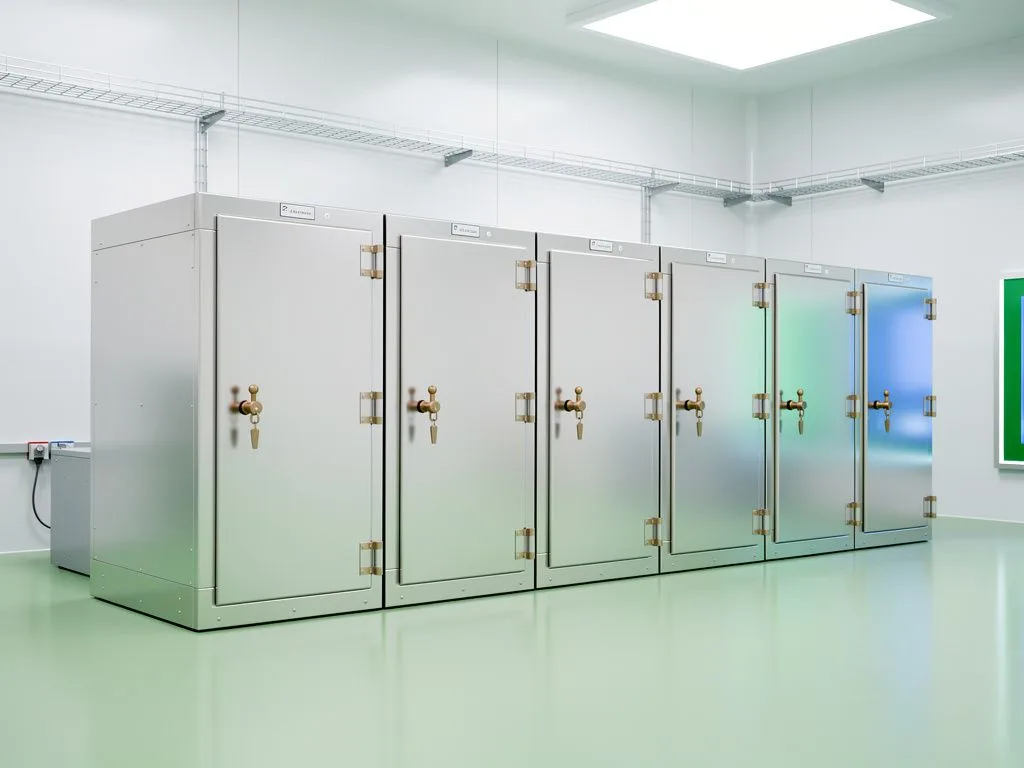
jintay-locks industrial-cabinet-1

How to Read IP Ingress Protection Ratings: What Each of the Two Digits Means

The IP (Ingress Protection) rating is defined by the international standard IEC 60529 and is expressed as "IP" followed by two digits. The first digit, ranging from 0 to 6, indicates the degree of protection against solid objects and dust, while the second digit, ranging from 0 to 9, indicates the degree of protection against liquid ingress. The higher the number, the stricter the protection. For industrial applications such as enclosures, distribution boxes, and outdoor storage cabinets, buyers should first determine the level of protection required for their target environment, then check whether the lock body or mechanical components can meet that requirement.
Key Takeaways

  • IP ratings consist of two digits

    IP protection ratings are defined by IEC 60529. The first digit (0-6) indicates dust protection, and the second digit (0-9) indicates water protection. Higher numbers mean stricter protection.

  • IP65 is common for industrial enclosures

    For indoor control cabinets, IP40 or IP54 is usually sufficient. For outdoor cabinets, IP65 is recommended. For underground or humid areas, IP67 or higher is required.

  • Test conditions matter more than the rating label

    IP rating test conditions include duration, water flow, and water pressure. Buyers should request a summary of the test report rather than accepting verbal claims.

  • Distinguish between lock body and complete unit IP ratings

    The IP rating of the lock body itself differs from the protection of the complete unit after installation. Also consider gasket aging and the IK mechanical protection rating.

What Does Each First Digit (Dust Protection) from 0 to 6 Mean?

The first digit measures the ability of the lock body or housing to resist the entry of solid objects, with seven levels from 0 to 6. Level 0 means no protection. Level 1 protects against objects larger than 50mm (e.g., the back of a hand). Level 2 protects against objects up to 12.5mm (e.g., fingers). Level 3 protects against objects up to 2.5mm (e.g., tools and thick wires). Level 4 protects against objects up to 1mm (e.g., thin wires and small screws). Level 5 is dust-protected (not fully sealed, but dust ingress does not interfere with operation). Level 6 is dust-tight (completely prevents dust ingress). For industrial enclosures, the common requirements are IP5x or IP6x. The former allows minimal dust ingress that must not affect mechanical operation, while the latter requires complete sealing. When requesting a quote, simply saying "dustproof" is insufficient; buyers must specify whether they need IP5x or IP6x, as these two levels differ significantly in sealing design, gasket materials, and machining precision costs.

What Are the Differences Between the Second Digit (Water Protection) from 0 to 9?

The second digit measures liquid protection, with ten levels from 0 to 9, but in practice, industrial lock bodies and enclosures commonly use levels 0 to 8. Level 0 means no protection. Level 1 protects against vertically falling water drops. Level 2 protects against vertically falling water drops when the enclosure is tilted up to 15 degrees. Level 3 protects against spraying water (within 60 degrees). Level 4 protects against splashing water from any direction. Level 5 protects against low-pressure water jets. Level 6 protects against powerful water jets. Level 7 allows temporary immersion in water up to 1 meter deep. Level 8 allows continuous immersion in water deeper than 1 meter (the exact depth is defined by the manufacturer). Level 9 corresponds to high-temperature, high-pressure cleaning. For enclosures and distribution boxes, IPx4 (splashing water) is typically suitable for indoor areas with cleaning operations, IPx5 or IPx6 is suitable for outdoor or semi-outdoor environments, and IPx7 and IPx8 are used for underground equipment rooms or humid areas that may be temporarily submerged. Buyers should note that IPx7 is not equivalent to IPx6: the former is an immersion test, while the latter is a jet test, and the two scenarios impose different requirements on the sealing structure.

industrial cabinet scene 1

Why Can't You Rely Only on the IP Rating Label Without Considering Test Conditions?

The test conditions behind an IP rating are more critical than the number itself. IEC 60529 specifies the test duration, water volume, water pressure, spray angle, and sample condition for each level. For example, IPx5 involves a water jet of 12.5 liters per minute for 3 minutes, IPx6 involves 100 liters per minute for 3 minutes, and IPx7 involves immersion in 1 meter of water for 30 minutes. In practice, some products are labeled IP65, but the actual test may have been conducted on a new, stationary sample at room temperature. Once installed in a vibrating environment or after prolonged use where gaskets age, the protection level may degrade. When inquiring with suppliers, buyers should request a summary of the test report (testing organization, method, and pass conditions) rather than simply accepting a verbal claim of "we have IP65." At Jin Tay Industries, the OEM/ODM process includes a testing and certification stage, but specific certification numbers and applicable product lines must be confirmed based on actual specifications.
What IP rating is typically required for locks on industrial cabinets and distribution boxes?

The IP rating required for locks on industrial cabinets and distribution boxes depends on the installation location and the degree of environmental exposure. For indoor control cabinets in dry environments, IP40 or IP54 is usually sufficient. For outdoor cabinets, semi-outdoor distribution boxes, or areas that may be exposed to rain, IP65 is recommended. For underground equipment rooms, humid factories, or areas subject to brief submersion, IP67 or higher is needed. Distribution boxes have an additional consideration: when the lock is located near ventilation openings or heat dissipation holes, dust and moisture may enter through other paths, so the overall enclosure's IP rating and the lock's own IP rating should be evaluated separately. Buyers should first assess the types of dust and water sources the lock will encounter, then determine the target rating, rather than simply applying the highest specification. Jin Tay Industries' smart lock platform supports padlock and cabinet lock formats and can be configured according to the application, but specific IP ratings must be confirmed based on the actual product.

industrial cabinet scene 2

How do IP ratings correspond to NEMA and IK protection ratings?

IP is the international standard (IEC 60529), but the North American market commonly uses NEMA 250 to define similar protection levels. There is a comparison table between the two, but they are not fully equivalent. NEMA 4 is close to IP66, NEMA 4X adds corrosion resistance requirements, and NEMA 6 is close to IP67 but has different definitions for submersion time and depth. Additionally, there is the IK protection rating (IEC 62262), which specifically measures mechanical impact protection, with numbers from 00 to 10 representing from no protection to withstanding a 20-joule impact. For industrial locks installed in locations that may be struck by tools or subject to vandalism, the IK rating is as important as the IP rating. If the product is to be exported to North America, buyers should also confirm the NEMA rating; if installed in public spaces or outdoors, it is recommended to require IK06 or higher.

When purchasing industrial locks, how should buyers confirm IP specifications with suppliers?

When asking lock suppliers about IP specifications, buyers should prepare four pieces of information: the installation environment (indoor/outdoor/underground), the main exposure sources (types of dust, water contact methods), the expected service life and maintenance cycle, and the target protection rating of the overall system. If a supplier only answers 'we can achieve IP65,' that is not sufficient. Buyers should further confirm: Is the test conducted by a third-party laboratory or in-house? Is the test sample the lock alone or including the installed state? What are the gasket material and aging life? These questions help buyers assess the supplier's depth of understanding of protection design. In the OEM process, Jin Tay Industries provides complete support from DFM design evaluation to testing and certification, but specific certification details must be confirmed based on the actual specifications and product line.

Six checkpoints for determining whether an IP rating is suitable for industrial applications

  • Check whether the first digit is 5 or 6

    IP5x is dust-protected but not fully sealed; IP6x is dust-tight. For long-term reliability in industrial dust environments, IP6x is recommended.

  • Check the water contact scenario corresponding to the second digit

    IPx4 protects against splashing water, IPx5/IPx6 protect against water jets, and IPx7/IPx8 protect against immersion. Each scenario has different requirements for the sealing structure.

  • Require test reports rather than verbal claims

    Obtain a summary of the report from a third-party testing agency, including the test method, sample condition, and pass criteria.

  • Distinguish between the lock's IP rating and the overall enclosure's IP rating

    The IP rating of the lock itself is different from the protection rating of the entire cabinet after installation; the two should be evaluated separately.

  • Consider gasket aging and maintenance cycles

    IP ratings are typically based on new product testing; sealing performance degrades over time, so maintenance and replacement planning should be considered.

  • Evaluate the IK mechanical protection rating as well

    For locks in outdoor or public spaces, in addition to the IP rating, it is recommended to require IK06 or higher to resist tool impact and vandalism.

What support can Jintai Industrial provide for ingress protection (IP) rating design?

Jintai Industrial's two main pillars cover travel security hardware and IoT smart lock platforms. For industrial enclosures and electrical distribution boxes, lock body designs can undergo DFM design evaluation based on the customer-specified IP rating, and are delivered through a complete process from mold development, prototyping and verification, testing and certification, to mass production. For IoT smart locks, the integration of Bluetooth, NFC, RFID, and cloud connectivity modules also requires consideration of sealing design to prevent electronic components from becoming weak points for moisture ingress. The specific achievable IP ratings, applicable product lines, and certification details must be confirmed based on actual specifications and project requirements. Buyers are advised to directly provide a description of the target environment and protection requirements, and the engineering team will assess feasibility.

FAQ

What is the difference between IP65 and IP66?

The difference between IP65 and IP66 lies in the second digit: IP65 protects against low-pressure water jets (12.5 liters/minute for 3 minutes), while IP66 protects against powerful water jets (100 liters/minute for 3 minutes). For outdoor environments that may be subjected to strong rain, IP66 should be selected.

Can IP67 replace IP66?

No. IP67 involves immersion in 1 meter of water for 30 minutes, while IP66 is a powerful water jet test. The scenarios are different, and the sealing requirements differ. If the environment may involve both powerful water jets and immersion, the product must be confirmed to pass both tests.

How can I verify a supplier's IP rating claims?

Request a summary of the test report from a third-party laboratory, including the test method, sample condition, and pass criteria. If the supplier only says 'we can achieve IP65' without providing a report, carefully assess their credibility.

How should I choose between IP5x and IP6x for industrial applications?

IP5x allows limited dust ingress that does not affect operation, while IP6x completely prevents dust ingress. In dusty industrial environments requiring long-term reliability, IP6x is recommended, as the cost differences in sealing design, gasket materials, and machining precision are significant.

Why should the lock body IP rating and the complete unit IP rating be considered separately?

The IP rating of the lock body itself differs from the protection of the complete unit after installation, as dust and moisture can enter through other paths such as ventilation holes or vents. Buyers should first assess the dust and water sources the lock body will be exposed to, then determine the target rating.

Need to evaluate IP ratings and lock specifications for industrial environments?

Provide your installation environment, dust and moisture exposure conditions, and the Jintai Industrial engineering team will assess feasible solutions and reply with a quotation.